Sunday, December 4, 2016
Course Improvements
Personally, I like the way the course is set up and there isn't much at all that I would change about it. Some of my favorite aspects of the course are: the grace period, the extra credit, and last but not least, the stories that we have to write. For someone who does feels the most motivated to do homework late at night/early morning, I really appreciate the grace period. I definitely overuse it but it has helped me to turn in so many more assignments than I would have if I didn't have that option. As for some feedback on the idea of changing the review weeks to planning weeks, I personally would not agree to it. Not that it isn't a good idea, it's just I rarely stick to any long term plans that I try to make so I don't feel like that option would really work for me but that's just how I am. For others, it could be of great help to them so what I would suggest is giving people the option to do either/or. This way people who prefer one method over the other can choose to do so without being forced to do either one of them.

Tuesday, November 29, 2016
Reading Notes: Seven Secrets from Hindu Calendar Art, Part C: Ardhanari's Secret and Shiva's Secret Part 1.
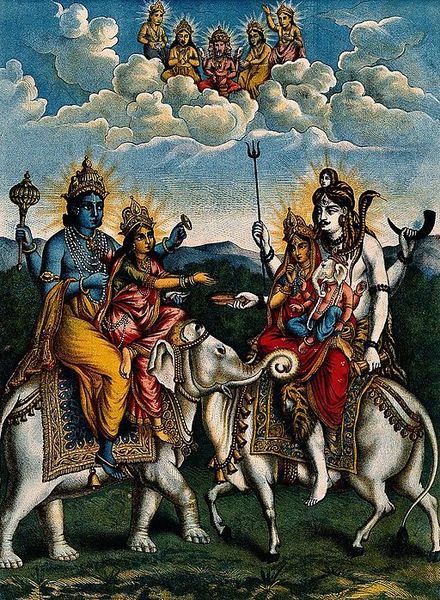 |
| (Vishnu and Lakshmi) |

In Hinduism, God is represented in many forms. He is best embodied in three couples: Brahma and Saraswati, Vishnu and Lakshmi, Shiva and Shakti.
Brahma: The Creator
Vishnu: The Sustainor
Shiva: The Destroyer
Lakshmi: Wealth
Saraswati: Knowledge
Shakti: Power
Since the river is always changing, one cannot step into it twice.
Shiva is known as the destroyer. He destroys desire, death, and the three worlds. The three worlds are: our private world, our public world, and the rest. This interprets out to be that Shiva destroys our desire for life, our fear of death, and the need for the world around us. Ash is the symbol of destruction and permanence because it is created by burning things but it itself cannot be burned.
Pattanaik, Devdutt. Seven Secrets of Hindu Calendar Art. Link to videos online.
Sunday, November 27, 2016
Portfolio Introduction
The Demon Within the Forest
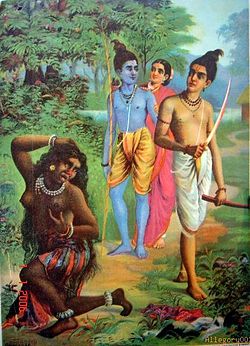 |
| (Soorpanaka on the ground in pain after her nose was cut off by Lakshmana. Rama and Sita are standing behind him. Image source: Wikipedia.) |
The mother of Rama, Kaikeyi, wants her biological son, Bharata, to
become the heir to the throne. She therefore orders Rama, her other son, to
be exiled to the forest. The story follows the journey of Rama, Sita, and Lakshmana as they encounter numerous obstacles during Rama's exile. They come to encounter the evil demon, Soorpanaka, who brings danger upon them. Will Rama be able to defeat Soorpanaka and save his family? Read to find out!
~~~~~~~~~~~~~~~~~~~~~~~~~~~~~~~~~~~~~~~~~~~~~~~~~~
Redemption's the Winner
~~~~~~~~~~~~~~~~~~~~~~~~~~~~~~~~~~~~~~~~~~~~~~~~~~
Redemption's the Winner
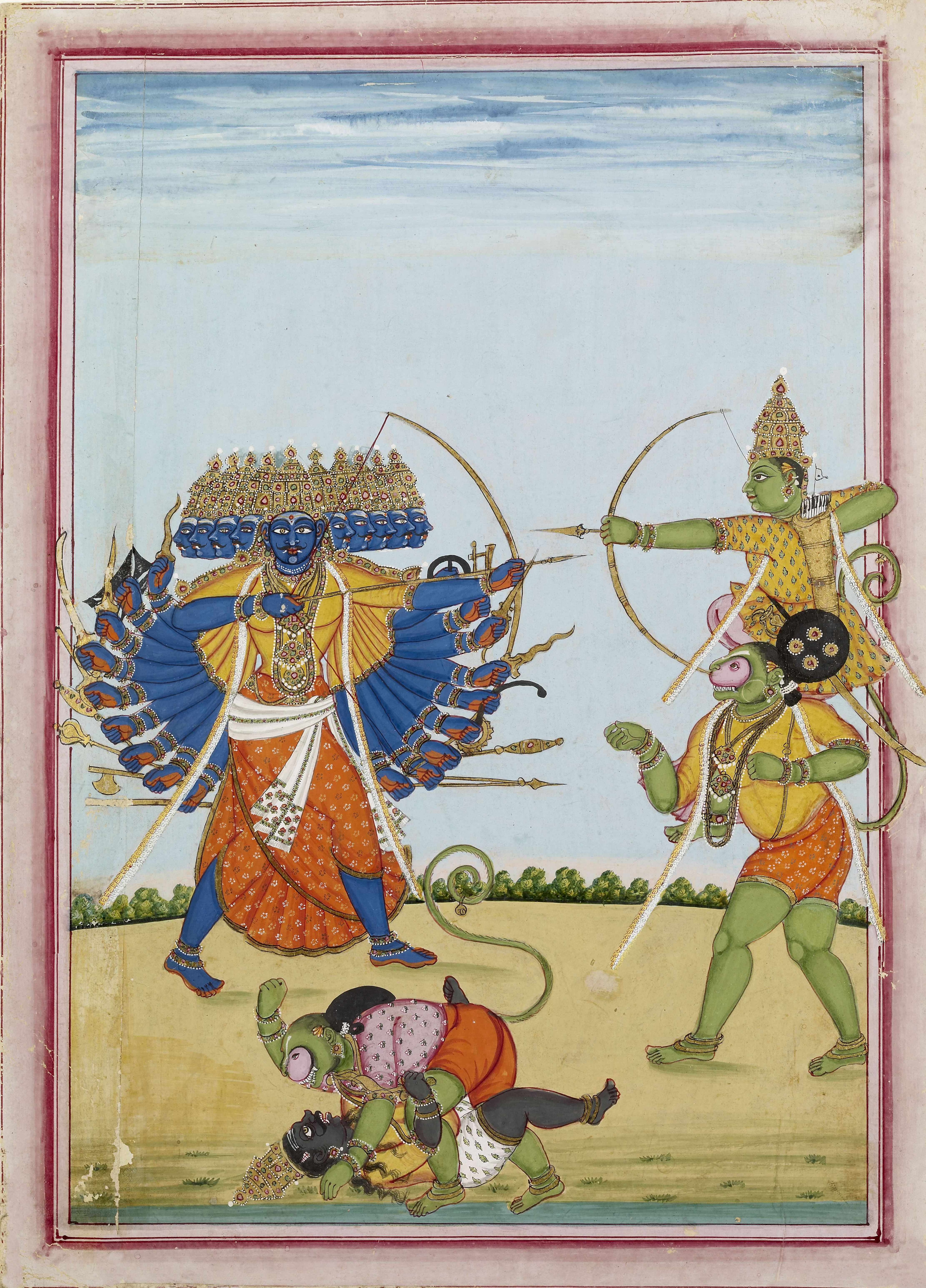 |
| (Ravana and Rama battling) Link to "Redemption's the Winner" Story. Infuriated, Rama wages a battle with Ravana to save his beloved wife. What will happen when Rama decides to unleash the Maya weapon? Will it be enough for him to save his wife? Or will he leave this battle empty-handed? Read to find out! ~~~~~~~~~~~~~~~~~~~~~~~~~~~~~~~~~~~~~~~~~~~~~~~~~~ The Reconciliation  Link to "The Reconciliation" Story |

Cursed, King Pandu relives his death over and over again. Will King Pandu be able to break this wretched curse? Or will he be doomed to die in the arms of his wife for eternity? Read to find out!
~~~~~~~~~~~~~~~~~~~~~~~~~~~~~~~~~~~~~~~~~~~~~~~~~~
How the Mind Kills
After finding out that one of the sons of his sister, Devaki, would one day kill him, Kamsa makes it his mission to stop this horrible fate. Will he be able to maintain his position on the throne? Or will he be doomed to meet this horrible fate? Read to find out!
~~~~~~~~~~~~~~~~~~~~~~~~~~~~~~~~~~~~~~~~~~~~~~~~~~
The Journey of Mohini
~~~~~~~~~~~~~~~~~~~~~~~~~~~~~~~~~~~~~~~~~~~~~~~~~~
How the Mind Kills
 |
| (Krishna killing Kamsa) Link to "How the Mind Kills" Story |

~~~~~~~~~~~~~~~~~~~~~~~~~~~~~~~~~~~~~~~~~~~~~~~~~~
The Journey of Mohini
 |
| (Mohini) Link to "The Journey of Mohini" Story Mohini just can't seem to find her purpose in life. Was she born to just exist? Or is there something bigger in store for her? Read to find out! |
.jpg)
Thursday, November 17, 2016
The Journey of Mohini
 |
| (Mohini) |

Mohini never felt like she belonged anywhere. She was adopted when she was a baby so she never got to know her birth parents. In school, Mohini didn’t have any friends. Many would make fun of her due to her being different. See, Mohini somehow always had the ability to attract bugs. Sounds weird right? Well, due to her strange ability, many would avoid even sitting near Mohini. She grew up with only a little bit of love, which was given to her by her adoptive parents. Although Mohini loved her parents dearly, she wanted to experience friendship. She wanted to be normal.
Mohini lived in such a small village that everyone basically knew each other. Her parents worked in the fields, tending to the land of a farmer who supplied a variety of crops a to big company. Their family made just enough money to get by. Their family resided in a small house made of wood. The house itself was old with some of the wood splitting and the tin roof starting to rust but the interior made it feel brand new. Inside the home was where Mohini lived her best memories. Since she never had any friends, Mohini spent most of her time with her family. She loved watching her mother cook and her father working on different chores in the house. This was before they started to work in the fields. Mohini’s parents wanted her to go to a good school so they had to start working in order to pay for it. That’s when Mohini began to feel more and more alone. She had always felt that a part of her was missing but she didn’t know what.
This year, many of the people who worked in the fields were getting laid off. Mohini’s village had been suffering a terrible drought and the since the crops were dying, the farmer wasn’t able to pay some of his workers so he had to let them go, Mohini’s parents included.
Every day, many of the villagers would gather to the center of the village to pray to the Gods. They prayed for an end to this terrible drought. Then one day, an old sage came.
“You need not worry! For the God, Vishnu, will be the one to stop this terrible curse! Legend says that Vishnu will one day come when there is a terrible drought and I believe that that time has finally come. We need not lose hope.”
Everyone thought that the sage was crazy. However, they did not want to lose hope as the sage had said in the case that Vishnu would actually come. They quickly began to prepare offerings to the God. Many brought fruits while other hunted animals. They earnestly waited the arrival of their savior.
At first, Mohini was happy that her parents no longer had a job. Now, she could once again spend time with them. However, her parents were deeply saddened by the whole ordeal. One day, when Mohini was on her way to the bathroom, she overheard her mom crying. This was the first time she had seen her mom sad. She didn’t know what to do so she ran out of the house. She ran all the way to the village. There, she saw the offerings that the villagers had prepared for Vishnu and it made her angry.
“Why aren’t you here? Why haven’t you saved us from this horrible drought?”
Mohini began to cry. She cried and cried. Then, as Mohini's tears hit the ground a single drop of rain hit her cheek. She looked up and suddenly, it began to pour. Everyone gathered to the center of the village and rejoiced. Then they began to look for Vishnu, who the sage had said would be the one to bring the rain. Suddenly, a bright light appeared and Vishnu now stood where Mohini had. The people gasped in shock of the sight they had witnessed.
“Hello, everyone. As you may have noticed, I am Vishnu. I have been asleep for centuries, waiting for the day that I would be needed. Your cries of help have awakened me.”
“Wait, so are you Mohini?” asked a villager.
“Mohini and I are one. She is me and I am her.”
So that’s how Mohini found the missing piece in her life. She had always gone about wondering what her purpose was. She always felt out of place, but not anymore. Mohini was the female form of Vishnu. With this newfound knowledge, Mohini lived her life helping others. She would become the light that would guide people. She would be the hand that reached out to those in need. She became the person who they needed when times were rough. Lastly, she would finally become the person she had always wanted to be for herself.
Author's Note:
For last week’s reading, I read about Mohini. She is known
as the female form of Vishnu. In history, Mohini is known as a goddess that
enchants lovers which ultimately leads to their doom. In my story, I wanted to portray
her in a different light. I made it to where she didn’t know that she was the
female version of Vishnu in order to create a story that would explain to the
audience how she came to find out she was. She finds out who she was after it was her tears that caused the rain to finally pour. My story portrays the journey of a
girl who was once lost but has now found her true calling in life. I chose this
topic because it is one that can be applied to all aspects of life no matter
the time we live in. Since I did not base my story off of another story, but
off of the fact that Mohini was known as the female form of Vishnu, I don’t
have much to explain in my author’s note. I just wanted to try and write a more
modern story while still applying original Hindu teachings that were well
known. I would still like to expand more on different parts of the story. I
hope you will enjoy!
Bibliography
Wednesday, November 16, 2016
Reading Notes: Seven Secrets from Hindu Calendar Art, Part A: Ganesha.
 |
| (Shiva, Parvati, Ganesha, and Kartikeya) |

Dharma- righteous conduct
Artha- economic activity
Kama- pleasurable pursuits
Moksha- spiritual practices
Turmeric is a golden herb associated with antiseptic properties. It's bright yellow color is associated with gold. The wives of Vishnu are Shri and Bhu. They are the Goddesses of wealth and earth. Kama is the Hindu cupid who is associated with the parrot and lotus.
Bibliography
Pattanaik, Devdutt. Seven Secrets of Hindu Calendar Art. Link to videos online.
Monday, November 14, 2016
Wikipedia Trail: From Mohini to the Peripheral Nervous System.
 |
| (Mohini) |

First, I started with Mohini. From there, I found that in the Mahabharata, Mohini appears in the form of Vishnu in order to take back the pot of Amrita from the asuras. Then from there, I found that remedies against leprosy can be found in plants that asuris have projected their powers into. Lastly from there, I found that leprosy is primarily a disease of the peripheral nervous system.
Wednesday, November 9, 2016
Reading Notes: Seven Secrets from Hindu Calendar Art, Part B: Narayan.
 |
| (Narayan) |

The world exists when Narayan is awake and ceases to exist when he is asleep. He sleeps on an ocean of still milk. It is a representation of possibility because Narayan is asleep, the world is nothing. However, when he is awake, there are many things that can become of the milk. The world isn't actually gone when Narayan sleeps. It's just that no one is aware of anything so we say that is ceases to exist. When Narayan finally opens his eyes, the world ceases to be as pure as it once was. the consciousness, which the video compares to a "uncreased piece of paper", is now creased. This "creased consciousness" is known as Brahma. when Narayan is awake, he is known as Vishnu.
Lakshmi- Goddess of wealth.
Tumburu- celestial musician.
Pralaya- the end of the world
Unlike in many of the Greek and Biblical worldviews, death is considered the end. In Hinduism, however, death is seen as a "comma", meaning that there is something that comes after it i.e. it is not a full stop.
Bibliography
Pattanaik, Devdutt. Seven Secrets of Hindu Calendar Art. Link to videos online.
Wednesday, November 2, 2016
Reading Note: Seven Secrets of Vishnu, Part A: Mohini.
 |
| (Vishnu) |

Mohini is the female form of Vishnu. Reality that you can experience through your senses is called material reality and it is represented by females. On the other hand, there is a type of reality that you cannot experience through your senses. This is called spiritual reality and it is represented by males. These two realities are interdependent of each other. Without one, you cannot have the other. This dependent nature of the two realities is expressed as a human couple in Hindu mythology. This mythology focuses a lot on the couple: the man and the woman. There are many physiological differences between a man and a woman that led to them be associated with the reality that they are now. Men create life outside of their body while women create life inside of theirs. Vishnu's sacred mark is known as the vertical namam. It includes both realities.
Material Reality: Red because it is the color of blood which sustains life
Spiritual Reality: White because it is the color of bones which keeps us upright.
Spiritual growth is one's ability to have material things while being able to overcome while still being able to enjoy them without greed. A goddess called is created because Brahma yearns for comfort. Maya constantly changes herself. That is why she is often seen as a delusion.
Culture: the world imagined and contructed by man with maya is known as Brahmanda.
Bibliography
Pattanaik, Devdutt. Seven Secrets of Vishnu. Link to videos online.
Sunday, October 30, 2016
Wikipedia Trails: From Draupadi to Neurons.
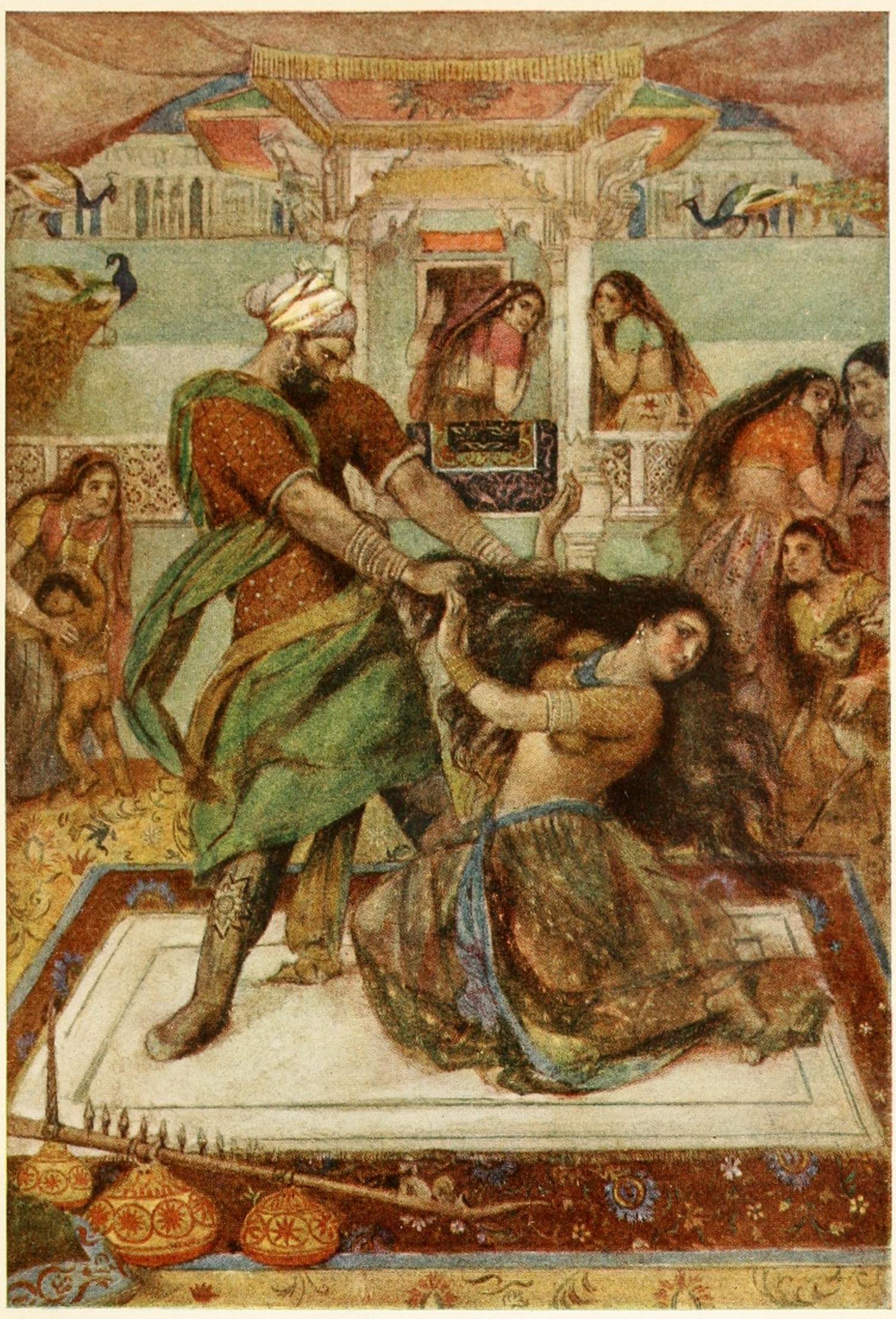 |
| (Draupadi being dragged from her chamber) |

First, I started with Draupadi. Then, I found that she had joke around and said "A blind man's son is blind", whenever she saw Duryodhana fall into the water. From there, I found that blindness can be caused by problems that occur in the brain. And lastly, from there, I found that the brain is composed of two types of cells: neurons and glial cells
Thursday, October 27, 2016
Story: How the Mind Kills.
 |
| (Kamsa getting warned by a goddess.) |
On the fifth night of the winter season, Devaki gave birth to her first son. Kamsa heard of this and made his way to where she was. Devaki knew of her brother’s evil plan so she had previously made plans with her husband, Vasudeva, and arranged for her son to be taken away to a safe place. Upon his arrival, Kamsa was furious to find out what his sister had done. As punishment, he ordered for her to be locked in a prison for the rest of her life.
The caretaker of Devaki’s son, Yashoda, named him Krishna. She nursed him as if he were her own. As he grew, Yashoda came to find out that Krishna was no ordinary child. One day when she found out that Krishna had been eating mud, she immediately tried to remove it by telling him to open his mouth. However, when she looked inside, it wasn’t mud that she found. Instead, inside Krishna’s mouth, Yashoda saw the entire universe.
At the age of fifteen, the city of Mathura were well aware of who Krishna was. Everyone recognized the greatness that he offered. At this age, Krishna also came to find out from Yashoda about his evil uncle.
The city of Mathura was a beautiful one. People roamed the streets while animals grazed the grass. However, Mathura was known for its powerful earthquakes. With one shake, thousands of innocent people lost their homes. Krishna wanted a structure that could withstand these powerful quakes so he asked the divine architect, Vishwakarma, to build him one.
“I have constructed you the world’s first indestructible building. However, there is one thing that can cause this building to fall: lead. Unfortunately, I am deathly allergic to it and therefore I don’t have knowledge of the material which is why I could not protect the building from it. So as long as lead does not touch these walls, the building will continue to stand tall.”
Devaki waited ten years before conceiving her second child. She thought that surely by now her brother would have let go of the thought that one of her children would kill him. However, she was terribly mistaken. One by one, Kamsa took Devaki's children from her and killed them. Kamsa would take her child to the forest and kill it by throwing it against the wall of what looked like an abandoned building. He loved his sister dearly but he couldn’t risk giving up his position. This horrible routine continued on for years. Kamsa constantly lived in fear that Devaki’s next child would be the one to kill him. This strain caused him to become delusional.
After he gained news that Devaki had had another child, he rushed to claim it. He once again proceeded to the abandoned building in the forest and continued his routine like normal. All of a sudden, the ground started to shake and the building collapsed, trapping Kamsa inside of it. It turns out that due to his mind being destroyed by the constant fear that he would someday die, Kamsa had hallucinated. He had thought that he was carrying the baby from the prison where his sister was kept to the forest when in fact he had grabbed a small statue from his home. That statue turned out to be made of lead and the building that he would go to in order to kill the babies was the building that Vishwakarma had built for Krishna.
In the end, Kamsa died not from one of Devaki’s children, but from the fault of his own deranged mind. After the whole ordeal, Krishna was finally reunited with his mother and he became the king of Mathura. People no longer had to live in fear. The city flourished under Krishna’s rule.
Author's Note:
In the original story, Krishna is born as the eighth child. The person who told Kamsa of his fate told him that it would be the eighth child of his sister that would one day kill him. Kamsa locks up his sister and her husband as a result of that. In order to make the story flow the way I wanted it to, I made it to where Krishna would be the firstborn child. That way, it would allow for Devaki, Kamsa’s sister, to have more children that Kamsa would kill over the years. I wanted him to be continuously exposed to this in order to show why he became mentally ill. In the original story, Krishna does return to the city of Mathura and kills his uncle. This caused an uproar amongst the allies of Kamsa. They began to continuously attack the city which prompted Krishna to take action. He asked the divine architect, Vishwakarma, to build him a new city, the city of Dwarka. In my story I made it to where Vishwakarma built him a building, which was where Kamsa would go to kill Devaki's children. As you can see, I decided to focus more on Kamsa than on Krishna, as it is in the original story. I wanted to demonstrate to the audience how powerful the mind can really be. The irony in the story was that in the end Kamsa wasn’t killed by any of Devaki’s children, but by his own mind. He brought about his own demise because he wanted to keep his power.
Bibliography
Epified TV (India). Krishna. Link to videos online.
Wednesday, October 26, 2016
Reading Notes: Epified Krishna, Part B.
 |
| (Krishna and Balram meet their parents) |
Bibliography
Epified TV (India). Krishna. Link to videos online.
Sunday, October 23, 2016
Wikipedia Trail: From Kunti to Birthdays.
 |
| (Pandu and Kunti) |

First, I started with Kunti. From there, I found out that she perished in a forest fire and attained heaven. From there, I discovered that in Greek thought, the immortal soul will return to the one who created it after death. Then from there, I found out that Judaism does not celebrate one's birth i.e. their birthday like we do, but one's death.
Tuesday, October 18, 2016
Reading Notes: Epified Krishna, Part A.
 |
| (Krishna and Radha) |

Bibliography
Epified TV (India). Krishna. Link to Reading Guide.
Sunday, October 16, 2016
Wikipedia Trails: From Carol Dweck to the Human Gastrointestinal Tract.
 |
| (Carol Dweck: Growth Mindset vs Fixed Mindset) |
First, I started with Carol Dweck. From there, I found out that she was a professor of psychology at Stanford University. From there, I found that the son of the founders of the university had died of typhoid fever. Lastly, from there, I found that the cause of typhoid fever is from a bacterium called salmonella typhi that grows in the intestines and blood stream.
Wednesday, October 12, 2016
Week 8 Growth Mindset: Becoming a Better Writer
 |
| (Tree growing out of a book) |
Monday, October 10, 2016
Week 8 Reflections: Connecting With Others
| (Person writing words on the board) |

Friday, October 7, 2016
Wikipedia Trail: From Drona to Herbivores
 |
| (Drona commanding the Kuru army) |
First, I started out with Drona. From there, I found out that he had discovered a dog that had arrows jammed in it's mouth. These arrows were later found out to be shot by one of his unknown pupils, Ekalavya. From there, I found that dogs are naturally predators and that now all predators are carnivorous, some are herbivores.
Reading Notes: Epified Mahabharata, Part B.
 |
| (Ekalavya) |
If I remember correctly, I believe that is was a Brahmin had cursed Pandu for shooting him. He cursed Pandu to died in the arms of his loved one. In the epified version however, Pandu is cursed to die whenever he becomes intimate with a woman. It is interesting to see the slight variations in the different versions of the Mahabharata. I did not know that this was a curse that had haunted Hastinapur for many generations. I was under the impression that it was a curse that was uniquely created for Pandu due to his actions. Yama is the the god of not only death but also truth. Pandu named his first son Yudhishthir. It was funny to see that their second son, Bhima, broke the rock he had fallen onto. Kunti refused to use the mantra anymore after the birth of their third son, Arjun. Kunti helped Madri have 2 sons and there were the 5 sons of Pandu. Madri took the leap of faith as she jumped into the fires with her dead husband. I was shocked to see that Ghandari had given birth to a lump of flesh. Vyasa did not want to harm the lump so he divided it into 100 pieces and placed them all into vats of oil. The first son to emerge was Duryodhana. They all looked demonic. Durodhana became jealous of all the love that Bhima was receiving. Duryodhana tries to push Bhima into the lake while he was in a deep sleep due to the laced food that he had eaten. Vasuki, the ruler of the serpent world, gives Bhima powers. They met Drona while trying to retrieve a ball from the well. Bhishma makes him their teacher. They all met Ekalavya in the forest when they saw how he had shut a dog up by jamming a bunch of arrows in the dog's mouth. It turns out Ekalavya had learned his archery skills from Drona, well kind of, he hand crafted an image of Drona after being rejected by him and practiced in front of that and became the world's best archer. Drona did not want him to beat Arjuna so he made Ekalavya cut off his right thumb and he did not hesitate to follow the orders of his guru.
Bibliography
Epified TV (India), The Mahabharata: Karmic Revolution. Link to video online.
Tuesday, October 4, 2016
Reading Notes: Epified Mahabharata, Part A
 |
| (Bhishma) |

Whenever I read something, I tend to just go over it without fully understanding everything that's happening. While I do know the overall plot-line of the story, I can sometimes overlook the important details. One of the main things that surprised me was the telling of how the first son of Shantanu, Devavrata, became Bhishma. I must have overlooked that part of the original Mahabharata because that was definitely news to me.
I really liked viewing the Mahabharata as an animation because it helped me to take the visuals that I had in my head and actually bring them to life.
I enjoyed watching about how Gandhari blindfolded herself for life in order to be equal to her husband, Dhritrasthra. Even though all of Hastinapur was happy for their marriage, Gandhari's brother, Shakuni (the future king of Gandhar).
Bibliography
Epified TV (India), The Mahabharata: Karmic Revolution. Link to video online.
Saturday, October 1, 2016
Wikipedia Trail: From Arjuna to Watermills.
 |
| (A statue of Arjuna) |
Subscribe to:
Posts (Atom)